Power Factor Correction Brisbane: 2026 Commercial Cost and Savings Guide
Power factor correction is the most overlooked commercial electrical investment in Brisbane. Most business owners have no idea their electricity bill includes a hidden penalty for low power factor. The fix costs $4,500 to $32,000 depending on site size and pays back in 18 months to 3 years through lower kVA demand charges. Energex actively penalises sites with PF below 0.9 because low PF reactive power wastes their network capacity.
This guide gives you the real 2026 SEQ Sparky pricing for commercial power factor correction in Brisbane, how PFC actually works, when fixed vs automatic banks are right, harmonics considerations, the Energex inspection process, and realistic payback analysis. I am Anthony Nuich, owner of SEQ Sparky (QLD Licence 90899). We have installed PFC for Brisbane factories, supermarkets, medical clinics, workshops and cold storage facilities.
Commercial PFC cost in Brisbane 2026 at a glance
| System size | Typical 2026 cost | Application |
|---|---|---|
| 15 kVAr fixed bank | $3,500 to $5,500 | Small workshop, office |
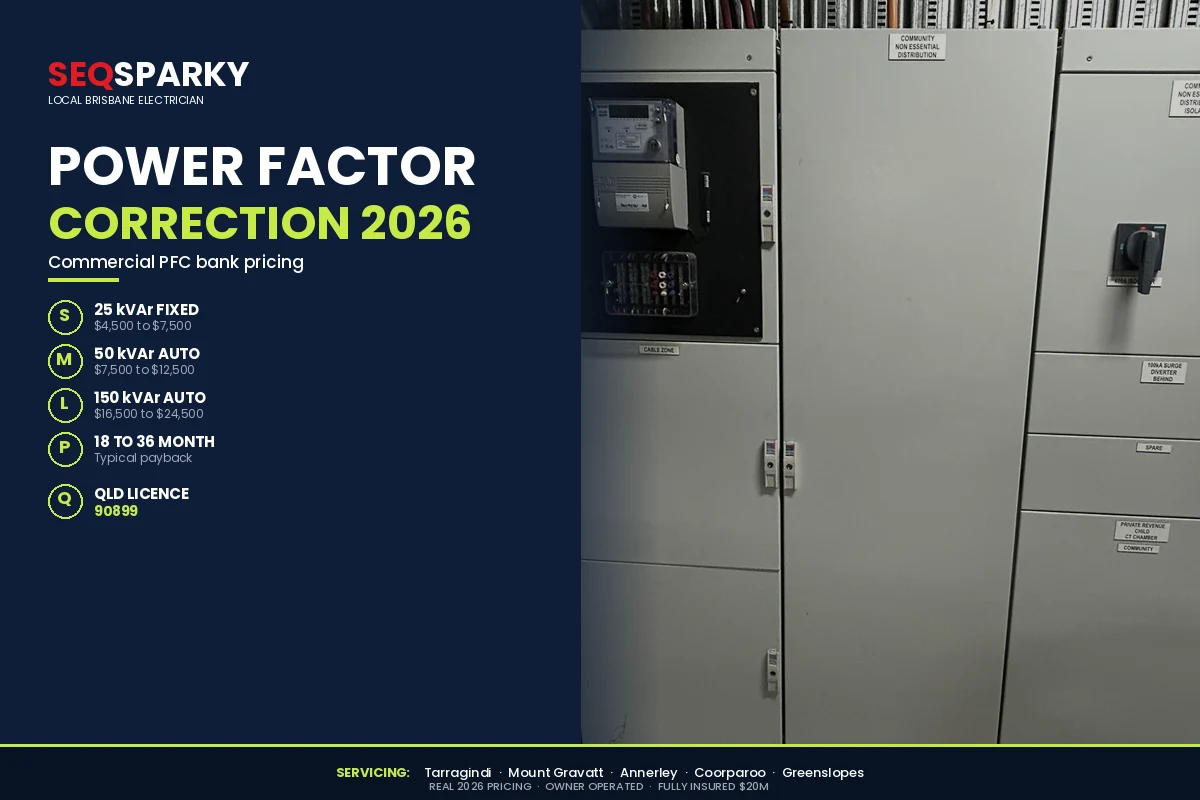
| 25 kVAr fixed bank | $4,500 to $7,500 | Cafe, small retail |
| 50 kVAr automatic bank (3 stages) | $7,500 to $12,500 | Restaurant, medium retail |
| 100 kVAr automatic bank (5 stages) | $12,500 to $19,500 | Supermarket, workshop |
| 150 kVAr automatic bank (6 stages) | $16,500 to $24,500 | Cold storage, factory |
| 250 kVAr industrial bank (8 stages) | $22,500 to $32,000 | Larger industrial site |
| Detuned bank (for harmonic loads) | Add 25 to 40 percent | Sites with VFDs, LEDs |
Turnkey includes capacitor bank cabinet, controller and switchgear, protection fuses per stage, all cabling from main switchboard, Energex EWR notification, commissioning and verification, and Form A compliance certificate.

What power factor is and why you are paying for it
Power factor is the ratio of real power (kW) to apparent power (kVA). A perfect power factor of 1.0 means every amp delivered does useful work. A power factor of 0.7 means 30 percent of the current is wasted moving reactive power back and forth between your site and the grid without doing useful work.
Reactive power is created by:
- Electric motors (especially under loaded motors)
- Welders and arc furnaces
- Fluorescent lighting ballasts (less of an issue now most sites have LED)
- HVAC compressors
- Refrigeration motors
- Pumps and fans
- Air conditioning
Energex bills commercial sites on a combination of kWh consumed and kVA peak demand. Low power factor inflates kVA without lifting kWh, so you pay more for the same useful work. PFC adds capacitor banks that supply reactive power locally, bringing PF back toward 1.0 and lowering your kVA demand bill.

How to know if your site needs PFC
- Check your electricity bill. Look for “kVA demand charge”, “kVAr penalty”, “reactive energy”, or “power factor adjustment”. If you see any of these, you have low PF.
- Look at the power factor value. Below 0.9 indicates room for improvement. Below 0.8 is a significant penalty.
- Equipment audit. If you have large motors, welders, or older HVAC, PF is likely below 0.85.
- Demand profile review. Sites with peaky loads (intermittent welding, lift starts, compressor cycling) have low PF during peaks.
- Energex notification. Energex sometimes contacts customers with very low PF asking for corrective action.
SEQ Sparky offers a free PF audit. We log your demand over 5 to 7 days, measure existing PF, calculate the kVA savings from PFC, and quote the right sized bank for your real load profile.

Fixed vs automatic PFC: choosing the right type
Fixed PFC
- One capacitor bank rated for the average reactive demand
- Always on, simple, no moving parts
- Cheapest option
- Right for sites with steady continuous load (cold storage, refrigeration, continuous production)
- Risk of over correction during low load periods (capacitive PF) which can also attract penalties
Automatic PFC
- Multiple capacitor stages that switch in and out based on real time reactive demand
- Controller measures PF continuously and adjusts
- Stages typically 5 kVAr to 50 kVAr each, with 3 to 8 stages per bank
- Right for variable loads (welders, intermittent machinery, mixed retail demand)
- More expensive but maintains optimal PF across all load conditions
- Contactor switched (cheaper, slower) or thyristor switched (faster, more expensive)
For most Brisbane commercial sites we recommend automatic PFC because the load is rarely truly steady. The cost premium over fixed is 30 to 50 percent but worth it for the consistent PF result.

Harmonics: when standard PFC is not enough
Modern Brisbane commercial sites have a lot of non linear loads that create harmonic distortion: variable speed drives, LED drivers, switched mode power supplies, UPS systems. Standard capacitor banks can resonate with harmonics, amplifying them and damaging the capacitors. Two solutions:
- Detuned PFC. Capacitor banks with inrush reactors tuned below typical harmonic frequencies. Protects the capacitors from resonance damage. Adds 25 to 40 percent to standard PFC cost.
- Active harmonic filters. Electronic devices that inject opposing harmonic currents to cancel distortion. More expensive but handle severe harmonics. $25,000 to $85,000 for typical commercial sites.
- Combined detuned PFC plus active filter. For the worst sites with severe harmonics and PFC needs.
We measure harmonic content during the initial audit. Most Brisbane commercial sites need standard or detuned PFC. Active filters are usually only required for large data centres, hospitals or specialised manufacturing.

Energex EWR and PFC installation
Any PFC install over 30 kVAr triggers an Energex Cat B or Cat C EWR. The lodgement covers:
- PFC bank rating and stage configuration
- Connection point on the customer side of the meter
- Protection settings to prevent capacitive over correction at low load
- Verification that PFC does not destabilise the upstream network
SEQ Sparky lodges the EWR, coordinates the Energex inspection, and provides Form A compliance on completion. Full EWR process detail in our Energex EWR Brisbane process guide.
What is included in a SEQ Sparky PFC install
- Free 5 to 7 day demand and PF audit
- Capacitor bank sizing calculation
- Recommendation on fixed vs automatic vs detuned
- Harmonic measurement and assessment
- Capacitor bank cabinet supply (Schneider, ABB, Eaton or equivalent)
- Controller programming and commissioning
- Connection to main switchboard with proper protection
- Energex EWR lodgement and inspection coordination
- Verification of PF improvement under load
- Form A compliance certificate
- Optional annual maintenance contract
Realistic payback analysis
Payback depends entirely on your existing kVA demand charges and current PF. Typical Brisbane commercial site examples:
- Small workshop with PF 0.78. 25 kVAr PFC at $5,500. Annual savings $2,800. Payback 24 months.
- Medium supermarket with PF 0.82. 100 kVAr automatic PFC at $15,500. Annual savings $7,200. Payback 26 months.
- Industrial workshop with PF 0.74. 150 kVAr automatic PFC at $19,500. Annual savings $13,500. Payback 17 months.
- Cold storage with PF 0.85. 50 kVAr automatic PFC at $9,500. Annual savings $3,400. Payback 33 months.
Numbers assume current Energex tariffs. Lower PF sites pay back faster. Sites with high kVA demand peaks (lifts, welders, large motors) often beat these payback periods.
Combining PFC with other commercial work
- CT metering install at the same time – see our CT metering Brisbane guide
- Switchboard upgrade with PFC integration – switchboard upgrade service page
- LED lighting retrofit with PFC for total bill reduction – commercial LED upgrade guide
- Solar install with PFC integration for net metering optimisation
- Industrial maintenance contract bundle – industrial electrician Brisbane guide
How to choose the right contractor for PFC
- QLD electrical contractor licence number on the quote
- Public liability insurance certificate (we hold $20 million)
- Cat B or Cat C Energex EWR experience
- Free demand and PF audit before quoting
- Brand name capacitor banks only (Schneider, ABB, Eaton)
- Harmonic measurement and detuned design capability
- Written payback analysis with assumptions disclosed
- Form A compliance included
- Annual maintenance contract option
For wider commercial electrical work see our commercial electrician Brisbane page.
Frequently asked questions
How much does power factor correction cost in Brisbane in 2026?
A 25 kVAr PFC capacitor bank for a small commercial site costs $4,500 to $7,500 turnkey. A 50 kVAr unit for a medium retail or workshop sits at $7,500 to $12,500. Industrial sites with 100 kVAr to 250 kVAr automatic banks range from $14,500 to $32,000 including switchgear protection and Energex notification.
How do I know if I need power factor correction?
Check your electricity bill for kVA demand charges or a separate kVAr reactive line. If your power factor is below 0.9, you are paying premium rates. Common triggers: industrial machinery, large air conditioning loads, welders, motors over 5 kW. Energex can also flag your site if PF drops too low.
What is the payback period for PFC installation?
Most Brisbane commercial PFC installs pay back in 18 months to 3 years depending on existing power factor and demand profile. Sites with PF below 0.8 see payback in under 18 months. Sites with PF around 0.85 to 0.9 see 2 to 3 year payback. Calculation comes from kVA demand charge reduction.
What is the difference between fixed and automatic PFC?
Fixed PFC capacitor banks are sized for the average load and stay on continuously. Cheaper, simpler, right for stable loads. Automatic PFC banks switch capacitor stages in and out based on real time demand. More expensive but ideal for variable loads like welders and intermittent machinery.
Do I need a controller and switchgear?
Automatic PFC needs a controller that monitors site reactive demand and switches capacitor stages accordingly. Plus contactors, thyristors for fast switching, and protection fuses for each stage. All housed in a dedicated PFC cabinet alongside your main switchboard. Fixed PFC just needs the capacitors and isolation switch.
Can PFC fix harmonic distortion issues?
Standard PFC alone does not address harmonic distortion. For sites with VFDs, LED drivers, switched mode power supplies and other non linear loads, you may need detuned PFC or active harmonic filters. We measure harmonic content during the initial site audit and design accordingly.
How long does PFC installation take?
A fixed PFC install takes 1 to 2 days on site. An automatic PFC system takes 2 to 4 days including controller programming and commissioning. Site outage usually 4 to 6 hours during the changeover. Energex notification adds 1 to 2 weeks at the end for inspection.
Will PFC reduce my actual energy consumption?
PFC does not reduce kWh consumption. It reduces kVA demand by aligning current and voltage waveforms. The result is lower demand charges on your bill plus reduced cable and switchgear losses. Many sites see 3 to 8 percent total bill reduction from the loss reduction alone.
Book a Brisbane PFC site audit
If your bill shows kVA demand charges and your power factor is below 0.9, PFC pays back fast. Book a free 5 to 7 day load logging audit and we will measure your real demand profile, calculate the optimal PFC bank size, and quote turnkey including Energex EWR.
Call SEQ Sparky on 0431 110 148 or request a quote through the commercial electrician Brisbane page. Brisbane Southside, owner operated, QLD Licence 90899, fully insured to $20 million.