Smoke Alarm Installation Brisbane: 2026 Cost and QLD Legislation Guide
Queensland has the strictest smoke alarm legislation in Australia and the deadline is closer than most Brisbane homeowners realise. From 1 January 2027 every single home in the state must have interconnected photoelectric smoke alarms with 10 year lithium battery backup in every bedroom, every connecting hallway and on each storey. The law already applies to all rentals and any property being sold. Get caught non compliant and your insurance can deny a fire claim outright.
This guide gives you the real 2026 SEQ Sparky pricing for Brisbane smoke alarm installation, the full QLD legal requirements, the difference between photoelectric and ionisation alarms, the interconnection standard, and what to do if your existing alarms are battery only. I am Anthony Nuich, owner of SEQ Sparky (QLD Licence 90899). Every smoke alarm install we do includes a Form A Certificate of Testing and Compliance.
Smoke alarm install cost in Brisbane 2026 at a glance
Pricing depends on the number of alarms required, whether the install is hardwired or wireless interconnected, and whether the existing wiring can be reused. Here are the real 2026 SEQ Sparky numbers for Brisbane Southside.
| Home size | Alarms required | Typical 2026 cost |
|---|---|---|
| 1 bedroom unit | 2 alarms | $480 to $750 |
| 2 bedroom unit or small home | 3 alarms | $650 to $950 |
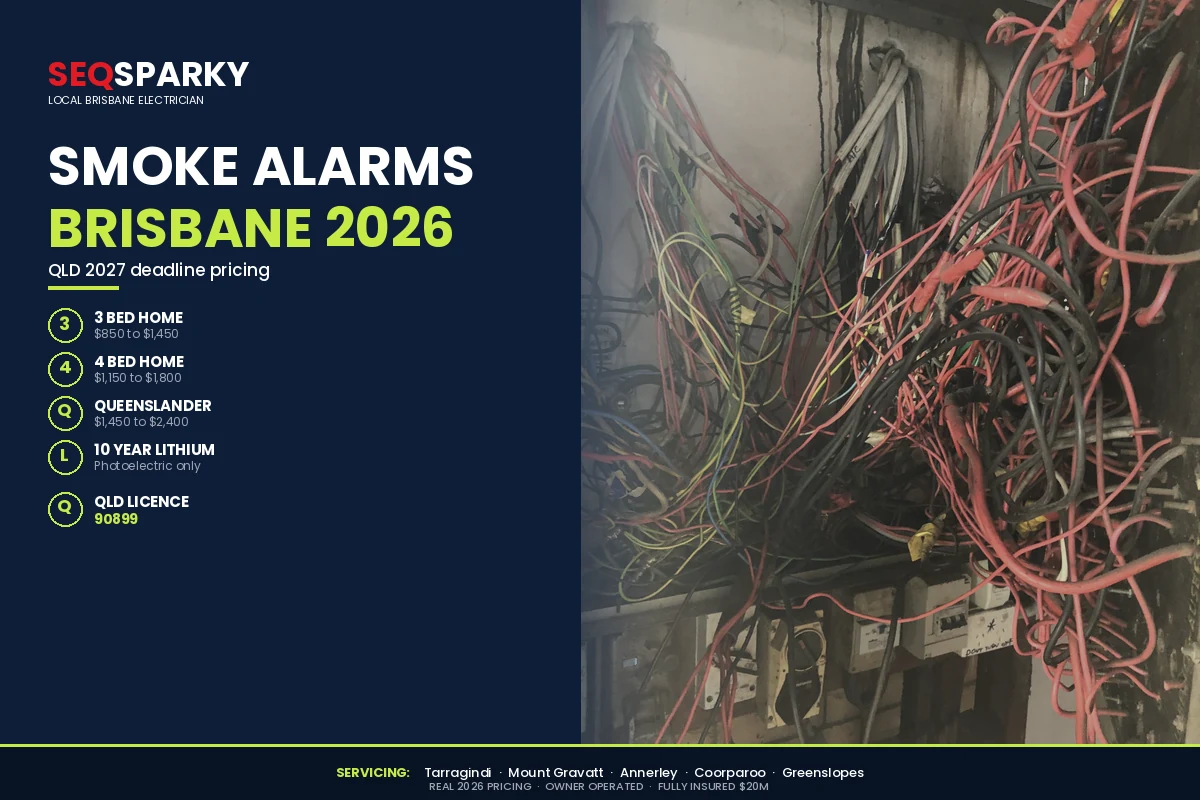
| 3 bedroom standard home | 4 alarms | $850 to $1,450 |
| 4 bedroom modern home | 5 alarms | $1,150 to $1,800 |
| Queenslander or two storey | 6 to 8 alarms | $1,450 to $2,400 |
| Single alarm retrofit | 1 alarm | $180 to $250 |
Pricing includes Clipsal, Brooks or Cavius brand alarms (no generic imports), full hardwired interconnection, mounting on every bedroom and hallway, system functional test, and Form A Certificate of Testing and Compliance. Pricing assumes accessible ceiling cavity. Subfloor wired access or Queenslander hardwood ceilings can add 10 to 25 percent.

QLD smoke alarm law 2026: what is required and when
Queensland legislation under the Fire and Emergency Services Act sets three escalating compliance stages:
- From 1 January 2017. Photoelectric alarms only (ionisation banned for replacements). Hardwired if main switchboard work occurs, otherwise 10 year lithium battery acceptable.
- From 1 January 2022. Full compliance required at change of property ownership and for new rental leases. Interconnected photoelectric in every bedroom, hallway and on each storey.
- From 1 January 2027. Full compliance required for every residential property in Queensland regardless of ownership status. No grandfather provisions.
If you own a Brisbane home that has not been upgraded since the 2017 changes, you have until late 2026 to be ready. Insurers and conveyancers are already asking for compliance certificates on every property transaction.
Where smoke alarms must be installed
- Every bedroom in the home
- Every hallway connecting bedrooms to the rest of the house
- If no connecting hallway exists, in the area between bedrooms and the rest of the home
- On every storey of multi storey homes (even if no bedrooms on that storey)
- Position on ceiling at least 30cm from any wall or light fitting
- Avoid kitchens and bathrooms (false alarm zones)
- Avoid air conditioning supply or return air outlets
We position every alarm per AS 3786 to minimise nuisance trips while maintaining detection sensitivity.
Photoelectric vs ionisation alarms (and why this matters)
- Photoelectric (QLD requirement). Uses a light beam scattered by smoke particles to detect smouldering fires earlier. Better at couch fires, electrical fires and overnight wiring faults.
- Ionisation (banned in QLD). Uses a small radioactive source to detect ions disrupted by smoke. Faster on flaming fires but slow on smouldering fires. No longer legal for any QLD residential property.
- Dual sensor. Combines photoelectric and ionisation. Accepted in QLD only if photoelectric performance meets AS 3786.
- Heat alarms. Trigger on temperature only. Used in kitchens and garages where smoke alarms cause nuisance trips. Cannot replace smoke alarms in bedrooms.
If you find an alarm in your home with an “I” stamp or “ION” marking, it is ionisation. Replace it now. Any alarm older than 10 years also needs replacement regardless of type.
Hardwired vs wireless interconnection
QLD legislation accepts both hardwired and wireless interconnection. The choice depends on your home’s wiring, ceiling access and budget.
Hardwired interconnection
- Mains power with 10 year lithium battery backup
- Interconnect cable runs between each alarm
- Most reliable, no battery dropout risk
- Requires ceiling cavity access for cable runs
- Best for modern homes with accessible ceiling
- Slightly cheaper per alarm
Wireless interconnection
- 10 year lithium battery powered only
- RF (radio frequency) interconnection between alarms
- No cable runs needed – minimal disruption
- Best for Queenslanders with limited ceiling access
- Best for renovated or owner occupied homes where cable installation is impractical
- 10 year lifespan then full replacement
For most modern Brisbane homes we recommend hardwired. For pre 1980 homes (especially Queenslanders) wireless is often the cleaner option. Full pricing context for older home electrical work is in our house rewire Brisbane cost guide.
What is included in a SEQ Sparky smoke alarm install
- Site inspection and compliance audit of existing alarms
- Supply of brand name alarms (Clipsal, Brooks or Cavius – no generic imports)
- Hardwired or wireless interconnection per scope
- Power supply from existing lighting circuit (or new circuit if required)
- Mounting per AS 3786 position requirements
- System functional test including interconnection verification
- Walk through with homeowner showing test button location and procedure
- Form A Certificate of Testing and Compliance issued same day
- 10 year manufacturer warranty registered
For landlords: tenancy change compliance
Every change of tenant in QLD triggers a smoke alarm test and reset. Your property manager handles this if engaged, otherwise it is the landlord’s responsibility. Items to check:
- Manufacture date on every alarm (10 year maximum life)
- Test button function on every alarm
- Interconnection test – one alarm triggers all alarms
- Photoelectric only (ionisation must be replaced)
- Position compliance against current legislation
SEQ Sparky offers landlord compliance packages for single properties and multi property portfolios. Single property check $250 to $450, multi property portfolios $180 to $320 per property. Full landlord compliance scope in our electrical safety certificate Brisbane guide.

For sale of property: Form 16 compliance
Selling a QLD residential property requires the seller to provide a Form 16 confirming safety switch and smoke alarm compliance. Buyer building inspectors verify:
- Interconnected photoelectric alarms in every bedroom
- Alarms in connecting hallways and on every storey
- 10 year lithium battery backup (not 9V)
- Hardwired or wireless interconnection working
- All alarms within 10 year service life
Non compliance can hold up settlement, force last minute installation at premium prices, or even kill the sale. Better to be compliant well before listing. See our safety switch installation Brisbane cost guide for the matching safety switch compliance side.
Brand selection: Clipsal vs Brooks vs Cavius
- Clipsal Firetek. Australian made, hardwired and wireless models, 10 year warranty, premium build. Most common in Brisbane installs.
- Brooks 5000 series. European made, very low false alarm rate, hardwired and wireless. Slightly more expensive.
- Cavius Wireless. Scandinavian made, smallest physical alarm, wireless only, ideal for heritage homes where visual impact matters.
We use these three brands only. Never generic imports because the after sales warranty and lifetime support matter when an alarm fails in year 8.
Maintenance schedule once installed
- Monthly. Press the test button on each alarm. Should hear loud beep within 5 seconds.
- Every 6 months. Vacuum the casing to clear dust and insect debris.
- Annually. Daylight saving clock change is a good reminder to test all alarms together.
- At 10 years. Replace every alarm (manufacture date printed on the back).
- At tenancy change. Full system test and reset with compliance certificate.
Combining smoke alarm install with other electrical work
Most homeowners save money by combining smoke alarm install with other electrical work. Common combinations:
- Switchboard upgrade plus smoke alarm install – see our switchboard upgrade Brisbane page
- Safety switch retrofit plus smoke alarm install – safety switch service page
- Full house rewire including smoke alarms – home rewiring service page
- Pre sale Form 16 compliance bundle – covers safety switches, smoke alarms and full electrical inspection
- Rental compliance bundle for landlords with multiple properties
Bundling saves callout fees and gets all your compliance done in a single visit.
How to choose the right contractor for smoke alarm install
- QLD electrical contractor licence number on the quote
- Public liability insurance certificate (we hold $20 million)
- Form A Certificate of Testing and Compliance included as standard
- Brand name alarms only (Clipsal, Brooks or Cavius)
- Interconnection test demonstrated on completion
- Written warranty on workmanship plus manufacturer warranty
- Compliance with current QLD legislation timeline
- Owner operator on site, not subcontracted
For broader residential context see our residential electrician Brisbane page. For rental property compliance see the strata electrician Brisbane page.
Frequently asked questions
How much do smoke alarms cost to install in Brisbane in 2026?
A single 10 year lithium photoelectric smoke alarm costs $180 to $250 installed. An interconnected hardwired smoke alarm install for a standard 3 bedroom Brisbane home (3 to 4 alarms) costs $850 to $1,450. A full QLD legislation compliance install for a 4 bedroom home (5 to 6 alarms) sits at $1,200 to $1,800 fitted.
What does the QLD smoke alarm law actually require in 2026?
From 1 January 2027 every residential property in Queensland (sold, rented or owner occupied) must have interconnected hardwired photoelectric smoke alarms with 10 year battery backup in every bedroom, every hallway connecting bedrooms, and on each storey. The current 2022 law already applies to all rentals and new sales.
Do I need interconnected smoke alarms?
Yes for all QLD residential properties from January 2027. Interconnected means when one alarm detects smoke, all alarms in the home sound together. This gives critical extra seconds of evacuation time. Wireless interconnection is accepted if hardwired interconnection is impractical.
How long does a smoke alarm install take?
A single retrofit takes 30 to 60 minutes including testing. A full home interconnected install for a 3 bed home takes 2 to 3 hours. A 4 bed or Queenslander takes 3 to 5 hours. We pull mains, run hardwire interconnection, mount each unit and test the full system before signing off.
Can I install smoke alarms myself?
For a battery only standalone alarm, yes. For any hardwired or interconnected installation in Queensland you need a licensed electrical contractor. DIY hardwired smoke alarm installation is illegal and voids your insurance. SEQ Sparky issues Form A compliance with every install.
What is the difference between photoelectric and ionisation smoke alarms?
Photoelectric alarms detect smouldering fires (couch fires, electrical wiring fires) faster. Ionisation alarms detect fast flaming fires faster. QLD legislation requires photoelectric only since 2017. Ionisation alarms are no longer compliant and must be replaced.
Do my smoke alarms need to be hardwired or can battery powered work?
For QLD compliance from January 2027 the alarms must be either hardwired with 10 year lithium backup, OR fully 10 year lithium with wireless interconnection. Standard 9V battery alarms are no longer acceptable. Replace any older alarms with compliant 10 year lithium photoelectric units.
How often should I test my smoke alarms?
Press the test button monthly. Vacuum the casing every 6 months to clear dust. Replace all alarms at the 10 year manufacture date (printed on the back). Every property change of tenancy or sale requires a full system test and compliance certificate.
Book a Brisbane smoke alarm install before the 2027 deadline
If your home was built before 2017 or has not been upgraded since then, your smoke alarms are very likely non compliant. Book a real assessment with QLD Licence 90899 and I will come out personally, audit your existing alarms, recommend the right brand and interconnection method, and quote a fixed price including Form A compliance. No callout fee for compliance bundles.
Call SEQ Sparky on 0431 110 148 or request a quote through the smoke alarm installation Brisbane page. Brisbane Southside, owner operated, QLD Licence 90899, fully insured to $20 million.